
On my Bookshelf | Martin Parr – Early Works
On my Bookshelf
In this column, I occasionally present a photo book that is close to my heart. It is not – or not necessarily – a new publication. It is simply a book that somehow fell into my hands and that I would like to recommend to others. And yes – of course it’s on my bookshelf.
It’s a bit of a continuation of my “Photo book of the month” column – just not necessarily as regular as before. And I’ve generally made the column a bit shorter and tighter. I hope you’ll enjoy it!
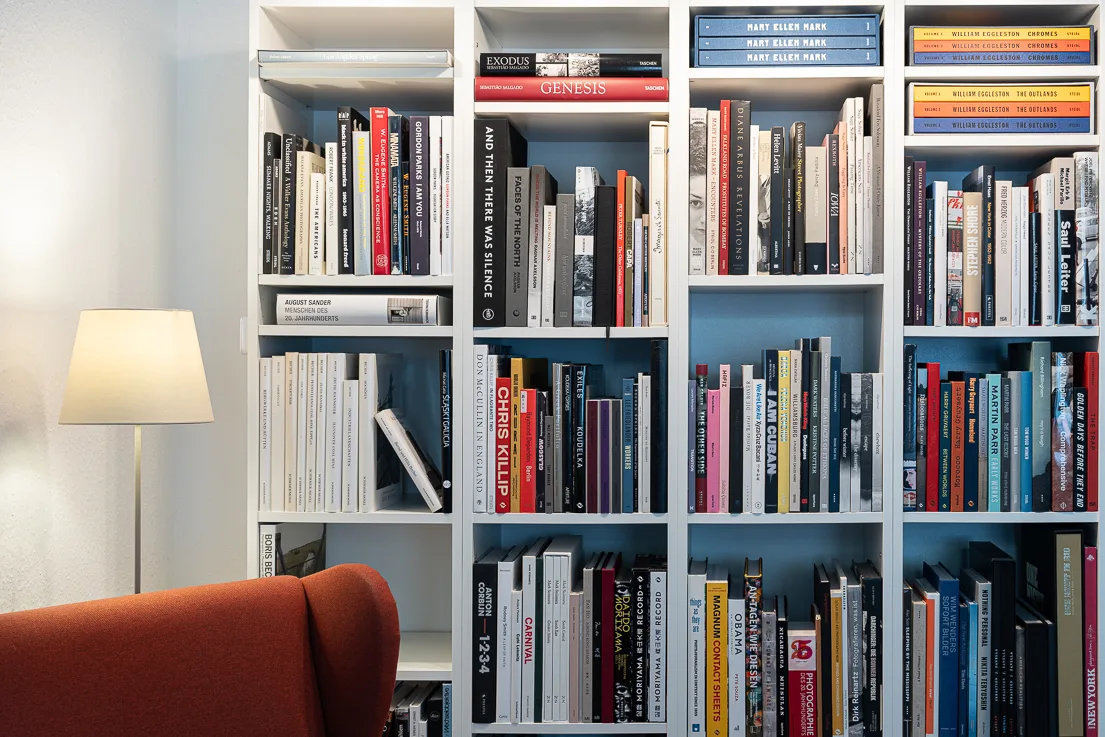
Prologue
The presentation of my book today is marked by a deep sadness. On 6 December 2025, Martin Parr passed away. The world has lost one of the greatest and most influential contemporary photographers of recent decades. It is a truly profound loss.
Martin Parr needs little introduction to a photography audience, but I will briefly introduce him nonetheless. He became renowned for his distinctive, humorous, and ironic view of the world—particularly of human behavior. He was especially drawn to travel and tourism, and to their sometimes bizarre excesses.
At the same time, he paid close attention to the everyday lives of people in his homeland, Great Britain. His most famous work in this vein is undoubtedly The Last Resort. I own and love this book, but it is not the Martin Parr I want to show you today.

Instead, I would like to introduce an earlier Martin Parr—one that perhaps fewer people know well. That is why I chose the book Early Works.


About the Photographer | Martin Parr
Martin Parr was a British photographer who was born in Epsom, Surrey, in 1952. He was supposedly inspired by his grandfather, who was an enthusiastic amateur photographer, and from a young age Parr already knew he wanted to make photography his career. He studied photography at Manchester Polytechnic from 1970 to 1973. After that, he worked as a freelance photographer while also continuing to lecture and teach.
During his first 20 years as a photographer, Parr built up a strong reputation and became fairly well known, especially for his social documentary work. Still, his acceptance as a full member of the Magnum photo agency in 1994 was a close call and quite controversial. Some people within the agency even campaigned against him, arguing that his style was too provocative and that it made fun of the people he photographed. Despite all that, Parr later went on to serve as president of Magnum from 2013 to 2017.
Martin Parr first worked mainly in northern England and later, from 1980, in Ireland, where he moved for a short time with his wife. Like most “serious” photographers at the time, he started out shooting only in black and white.
In 1982, the couple moved to Wallasey in England, and that’s when Parr switched permanently to color photography. Between 1982 and 1985, he took the photos for his well-known series Last Resort. Then, in 1987, the family—now with a daughter—moved to Bristol. In the years that followed, he went on to create countless projects on topics like the English working and middle classes, global consumer culture, mass tourism, and many other issues—most of them focused on social life and everyday behavior.
Parr lived in Bristol until the end of his life in December 2025.
Work and legacy
Trying to list even a small portion of Parr’s projects, books, or exhibitions is almost impossible. It’s fair to say he was one of the most prolific, and maybe even most obsessive, photographers of his generation. He published more than 140 books himself and edited another 30 on top of that.
The danger with photography is that it looks very easy but in fact, it’s a very difficult medium to really excel well in because basically, people don’t work hard enough – they’re lazy. Don’t be lazy!
Martin Parr
Parr was also an obsessive collector, especially when it came to photography books. His personal collection is said to include around 13,000 volumes.
Martin Parr Foundation (MPF)
In 2014, he set up the Martin Parr Foundation in Bristol, UK. The foundation supports emerging, established, and often overlooked photographers who focus on Britain and Ireland in their work. It runs a program of events, workshops, and exhibitions in its own gallery and event space.
The foundation also has a growing collection of important photobooks, book designs, prints, magazines, and Martin Parr’s own archive. Overall, it aims to make photography interesting and accessible to everyone, while also reflecting the diversity of British and Irish culture.
About the Photo Book | Early Works
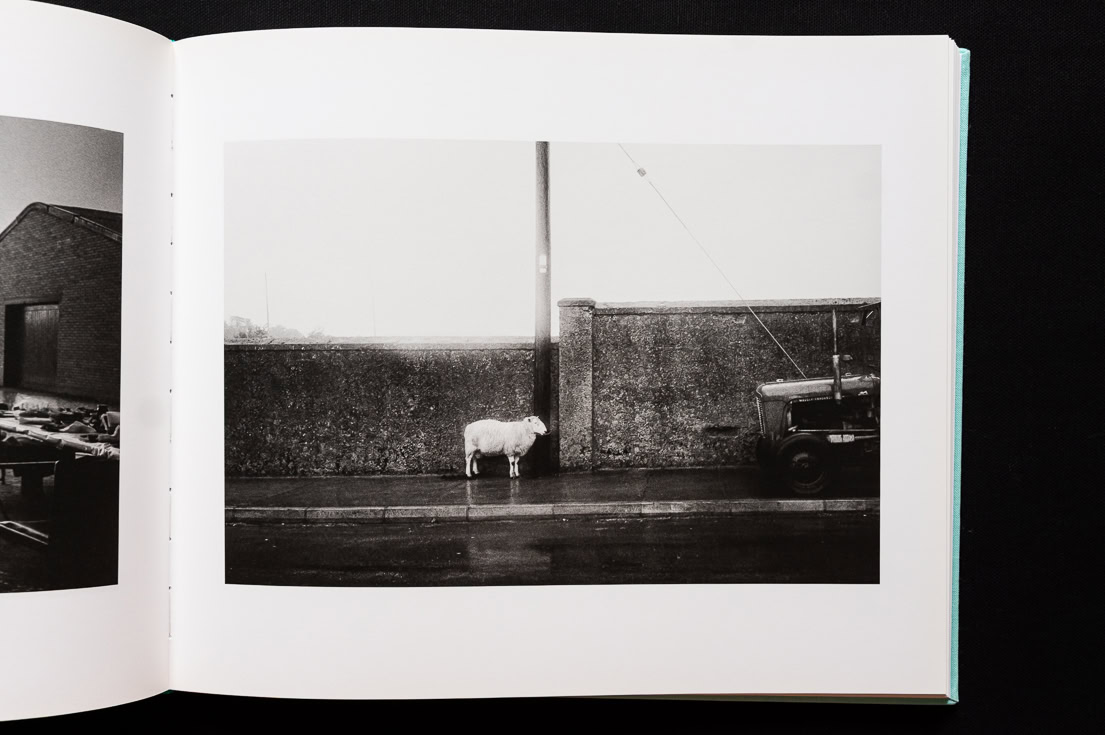
Early Works, first published in 2019, brings together 103 photographs from Martin Parr’s formative years, spanning 1970 to 1984, across 144 pages. The collection consists entirely of black-and-white images, most of them taken in northern England and Ireland. Many of these photographs are previously unpublished, while a small number will be familiar to readers from Bad Weather, Parr’s first book, released in 1982.
If you leaf through this book with a reasonable familiarity with Martin Parr’s work, it can feel strange at first. The vivid colours so characteristic of his style are, of course, absent, and some of the photographs aren’t ones you’d immediately associate with Parr. There are cityscapes of what at first glance seems like simply gloomy northern England, as well as documentary scenes from pubs. If I didn’t know better, I might have guessed that some of the images were by Chris Killip.


At second glance, however, the Parr we know becomes increasingly recognisable. Many of the images only need to be imagined in colour—and perhaps with people in different clothes—for us to feel “at home” again. Or at least “on the way there.”
In his brief introduction, Jeffrey Ladd describes his first impressions like this: “… I remember thinking that holding this early publication by Parr at that moment felt like looking backwards – like learning something in reverse order.” Strictly speaking, Ladd is referring to his initial encounter with Bad Weather, but the sentiment applies just as well to this book.
Early Works, first published in 2019 by RRB Photobooks, was followed by a revised second edition in 2025, which remains available today. Both editions are beautifully bound in linen and showcase one of the book’s own photographs as a print on the cover.
Why do I recommend this book?
The simple answer: if you love photography, it’s impossible not to recommend Martin Parr.
Beyond that—and aside from my desire to honour Martin Parr after his sad passing—I find this book fascinating for several reasons. It shows the path an artist has taken and how his work has evolved over time. If we look closely, it can also reveal something about the person himself and his view of the world.
The Martin Parr we know
I’ll begin with the Martin Parr that many people know today: colourful, slightly weird, and provocatively funny. The images from the aforementioned Last Resort exemplify this approach and are, of course, what made Parr famous with a wide audience.

We are also familiar with his pictures of mass tourism and its often amusing, sometimes bizarre, escapades, seen in many books and exhibitions.

I believe that much less well known to the general public, however, are his many detailed works on topics such as food. Martin Parr has often approached these with meticulous attention and obsession. Similarly colourful, but much more up close—Parr as a food photographer of a very special kind.

But what has almost always been characteristic of Martin Parr’s motifs—even during his travels around the world—is his keen interest in everyday life. His favourite subjects are quite literally found on the street, on the table, at his feet.
The extraordinary in the ordinary
Even though Martin Parr travelled the world and visited many famous—and for some even exotic—places, his focus was always on people and the ‘ordinary’. But for him, the ordinary was not ordinary at all, but exciting and interesting in itself.
This way of seeing is already evident in his early photographs from his homeland. Parr searched for moments that revealed the small world around us as it appeared through his eyes. Whether we enjoy what he sees, or how he shows us to ourselves, is another question altogether. 🙂
I photograph people as I find them. But people have issues about how they look.
Martin Parr
But he finds those moments and places where the ordinary seems extraordinary.


Despite the enthusiasm for the humorous, tongue-in-cheek perspective and style, we should not forget that these images are, at their core, highly documentary. They show the world, everyday life, and above all ourselves—with all our quirks—just as we are and were. That is what makes them a precious treasure whose value cannot be overstated.
Martin Parr’s early black and white photographs of the North of England are a remarkable record of an all-but disappeared society. When we remember the 1970s, our vision is informed by Parr’s photographs: lyrical, solemn, respectful, full of longing; the ordinary made extraordinary.
Val Williams
Bird-watching clubs in Surrey, trips to see the Pope in Ireland, holidays in the Scottish Highlands, local football matches, and traditional village festivals all caught the attention of a young Martin Parr. Even back then, two things distinguished his photography: exaggeration and intensity. His images are powerful because of how closely he observes everyday life and how much care he gives to things most people overlook. From local customs and street scenes to unpredictable British and Irish weather, Parr invites us to look again—and notice the strange, funny, and quietly absurd moments that shape ordinary life.
In this sense, the images in Early Works offer a double pleasure, showing a world that no longer exists through Parr’s unique, ironic perspective.


An extra dose of humour
Unfortunately, I never had the honour of meeting Martin Parr in person. Yet the wealth of interviews, videos, and documentaries about him allows for a meaningful impression of who he was. One trait, above all, comes through with clarity: his humour—arguably the very embodiment of English wit. This humour, paired with his extraordinary eye for scenes and fleeting moments, is already unmistakable in his early work.


I will sorely miss his view on the world—and his humour. R.I.P.

Thanks for showing us these wonderfull books. They show us a photographer who has had an special eye for human living.
Hello Volker,
I’m glad you find the book recommendations inspiring…
Peter
Hi Peter,
unlike other photo book reviews of yours, this one came for free – because I already own this book…
This is meant as a compliment on your photo book reviews!
How about your recent one camera/lens/year approach? Any resumee?
Kind regards,
Stefan
Hi Stefan,
Thank you very much for your kind comment, and I am of course delighted that I was able to help you save money this month. 😉
As for the cameras: the Q3 is and remains brilliant, and I’m not using the rest of my new purchases enough at the moment… but that’s due to a lack of time. I’ll take a look at that this in this very exciting year, and maybe I’ll go back to the one camera, one lens logic that I had temporarily abandoned for a planned project…
Peter
Schön, dass Sie diesem großartigen Fotografen einen Post widmen. 2024 habe ich eine Ausstellung von Martin Parr in der Leica Galerie in Frankfurt besucht und war schwer beeindruckt.
Sein Buch “Fashion Faux Parr” habe ich noch vor seinem Tod bei der MPF in England als signierte Ausgabe bestellt. “The Last Resort” ist genau die richtige Empfehlung, wenn jemand sein Werk kennenlernen möchte.
Gruß
Michael
Hallo Michael,
vielen Dank fürs Lesen und den Kommentar. Ja, er war wirklich großartig, und sein Werk bleibt es ja zum Glück weiterhin. Leider hatte ich nie die Gelegenheit, eine Ausstellung von ihm zu sehen. Vielleicht schaffe ich das ja nochmal irgendwo. Die MPF bleibt ja wohl weiterhin aktiv…
VG Peter
Hello Peter,
Thank you for remembering Martin Parr in your blog. Before his death, he was able to help curate the comprehensive exhibition “Global Warning” at the Jeu de Paume in Paris. This retrospective showcases his entire range of skills as a photographer—and his concern for us humans. Many of the pictures left me wondering whether to laugh or cry.
For anyone interested in Martin Parr, it’s worth making the trip to Paris before May 24, 2026; be sure to get your tickets in advance.
https://jeudepaume.org/evenement/martin-parr-global-warning/
Best regards,
Jürgen
P.S. In September, I want to travel to Japan with light luggage and am once again tempted to leave all my gear (Fuji X-T5 and lots of good lenses) behind in favor of the Leica Q3.
Hi Jürgen,
Thank you very much for your kind comment and tips. Unfortunately, I won’t be able to come to Paris before May 24, as we will be living in Washington D.C. from April onwards – which is exciting enough. But I’m sure it’s a great exhibition.
Peter
P.S. Japan is actually very high on my bucket list, but that will certainly have to wait a little longer at the moment. Have a great time there! And you really shouldn’t take a lot of equipment with you, at least in my opinion 😉
Vielen Dank für diese wunderbare Hommage an Martin Parr und den Einblick in sein faszinierendes Frühwerk, das zeigt, wie präzise er schon damals das Außergewöhnliche im ganz Gewöhnlichen eingefangen hat. Es ist ein schöner Gedanke, dass seine Arbeiten uns gerade jetzt, nach seinem traurigen Abschied, dazu einladen, den eigenen Blick für die humorvollen und absurden Momente des Alltags zu schärfen. Mein Tipp für dich: Da du bald in Washington D.C. lebst, könntest du versuchen, die dortige Street-Szene ganz im Stil von Parrs „Early Works“ in Schwarz-Weiß zu dokumentieren, um den Kontrast zwischen der monumentalen Architektur und den flüchtigen menschlichen Momenten herauszuarbeiten.
Hallo Marc,
vielen Dank fürs Lesen und ja, Martin Parr ist sicher nicht erst Martin Parr geworden, als er Last Ressort rausgebracht hat. Sein Kopf wird sicher diese Entwicklung über viele Jahre gemacht haben. Was Washington angeht: erstmal ankommen und sehen, was es da so gibt. Ich bin mir aber sicher, dass es in Farbe wie in SW genügend spannende Themen geben wird… 😉
VG Peter