
On my Bookshelf | Matt Black – American Geography
On my Bookshelf
In this column, I occasionally present a photo book that is close to my heart. It is not – or not necessarily – a new publication. It is simply a book that somehow fell into my hands and that I would like to recommend to others. And yes – of course it’s on my bookshelf.
It’s a bit of a continuation of my Photo book of the month column – just not necessarily as regular as before. And I’ve generally made the column a bit shorter and tighter. I hope you’ll enjoy it!

Prologue
I went back and forth for quite a while trying to decide which book would be my personal Book of the Year for 2025. Not only did I have far too many worthy contenders, but I also had to figure out what criteria should guide my choice. Should I approach it strictly from a photographic standpoint? Prioritize innovation? Choose something moving or thought-provoking? Or should I simply follow instinct and make an emotional, gut-driven decision?
In the end, I selected a book for reasons that are deeply personal — more on that soon. The book is American Geography by Matt Black. It isn’t light, cheerful, or particularly hopeful — just to set expectations. But that’s exactly what makes it so important.
About the Photographer | Matt Black
Matt Black is an American photographer. Born in Santa Maria in 1970 and raised in the small town of Visalia in California’s Central Valley, he discovered photography in high school, working part-time for local newspapers and developing the black-and-white, photojournalistic style that would define his career.
In the early 1990s, he made several trips throughout Latin America to create photographic work. In 1994, he earned first prize in the Daily Life category of the prestigious World Press Award. Black has also been recognized three times with the Robert F. Kennedy Memorial Prize, receiving its highest honor for journalism. In addition, he has been awarded the W. Eugene Smith Grant for Humanistic Photography and named a Senior Fellow of the Emerson Collective. He was nominated for Magnum Photos in 2015 and became a full member in 2019.
We are not photographers – we are no longer technicians with a camera – but we are authors. Our role is to tell stories by not merely illustrating but creating.
Matt Black
But his enduring, and increasingly dominant, focus became his home region of the Central Valley — its stark contrasts, its struggles, and its human stories. Over the years, this evolved into a lifelong photographic and journalistic engagement, especially with the lives of the people who inhabit the heartland of America’s fruit, nut and vegetable production.
The starting point for his largest photographic project to date — American Geography — also lies in the Central Valley, both geographically and metaphorically.
About the Photo Book | American Geography
The project
American Geography is the long-awaited book accompanying Matt Black’s eponymous project, a multi-year undertaking shaped by extensive travel. After beginning in his native Central Valley in 2014, Black embarked on five major trips across much of the United States between 2015 and 2020.
He was driven by a central question: could what he had witnessed at home also be found elsewhere in America? By this he meant another America — one marked by poverty and precarity, inhabited by workers, pickers, migrants, and others living on the margins. Or in short: by the overlooked.


The book
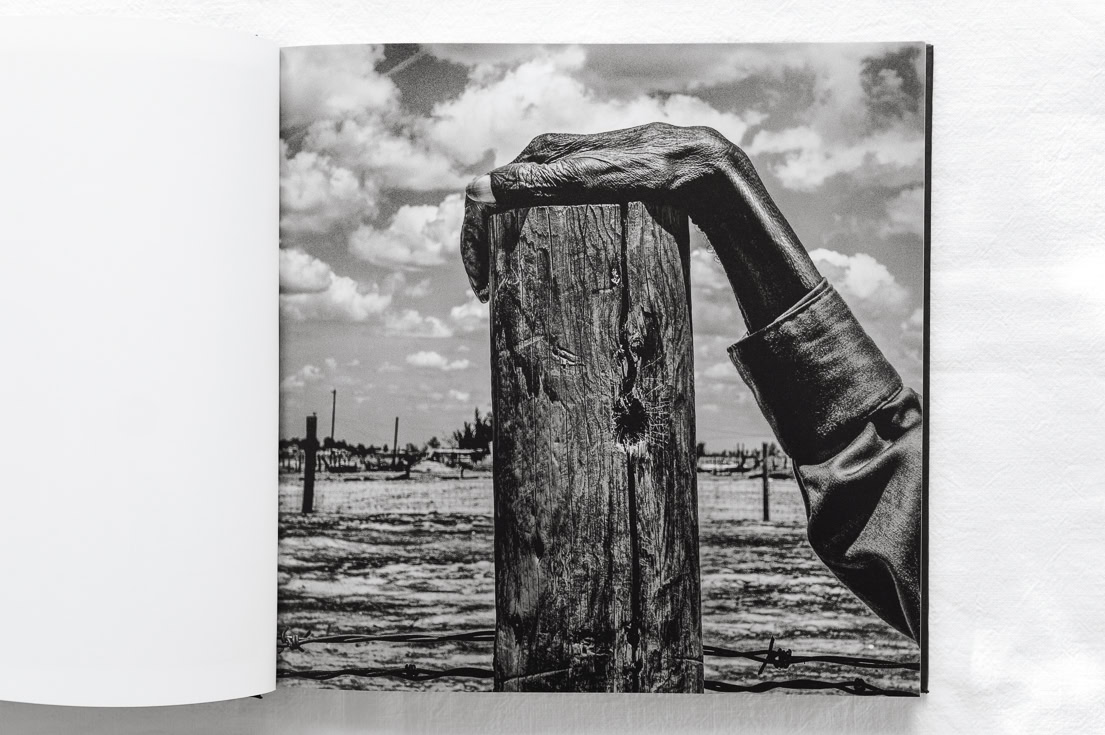
The result is a documentary, visually striking book that often cuts deep. Divided into four chapters — South and West, South and East, North and East, and North and West — Matt Black presents 97 black-and-white photographs that reveal an America far removed from the glossy, idealized image. Across 168 pages, he offers an unvarnished look at lives and reality not always seen in such clarity.


These images can be portraits, street scenes, landscapes, or an interplay of them all. Matt Black is drawn to the subtle, easily missed moments—the insignificant and invisible threads that still relate back to the central narrative.


He also invites us into his inner world through the thoughts and notebook fragments scattered throughout the book. At times, he focuses on the visual markers of poverty and marginalization—empty liquor bottles, discarded cigarette packets or pleas for help on walls. He assembles these elements with an austere clarity rooted in the spirit of New Objectivity, echoing the industrial studies of Bernd and Hilla Becher.


Published in 2021 by Thames & Hudson, this powerful and beautifully made book is still available new at an affordable price.
If you’d like to explore more deeply the artifacts that Matt Black has found, collected, and photographed, there is a companion volume to American Geography titled American Artifacts, published in 2024 by Thames & Hudson. Black himself characterizes the work as a kind of “sidewalk archaeology” of America’s poor.

Why do I recommend this book?
The very meaning of photography
Photography can be fun, colourful, glamorous — sure. But if that’s all we demand of it, we reduce the medium to decoration. We strip away the very thing that has kept photography relevant for more than a century: its capacity to question, reveal, unsettle, and carry weight. Serious photography isn’t just about producing something pretty; it’s about meaning. And pretending otherwise weakens the craft. At least, that’s how I see it.
I’m fairly certain Matt Black would stand firmly on this side of the argument — despite the fact that I’ve never spoken to him. Spend any real time with his work and you’ll see immediately how seriously he treats the medium. For Black, photography isn’t decoration; it’s impact, intention, and consequence. His images make plain what the medium is capable of — and what it should demand of us.
I simply try to show the thing I am photographing as honestly as I can, being true to what’s there and to my own feelings as an observer. I think of it as emotional honesty.
Matt Black


I want to make it clear that Matt Black’s focus lies not in the medium itself but in the subject matter—people, society, and reality. Photography, along with occasional short films and texts, simply serves as the vehicle through which he expresses these concerns.
To me, a picture is something that happens, and my part in the process is simply to be receptive, to be open.
Matt BLACk
That being said, it’s not that Matt Black overlooks composition or photographic beauty—if anything, he masters them. I’m blown away by his images: their tone, their atmosphere, their compositional strength.


But his journey across America wasn’t just a hunt for compelling images. It was a search for something more personal—answers, clarity, a sense of what’s real. Anyone who doubts that should look at his notebook entries or his Reading American History page, where he outlines the project’s roots and the questions that drove it.


It’s the people that count
As I said earlier, even with all the technical brilliance and visual subtlety, this work isn’t about the pursuit of fine art. It’s about the human stories and emotions embedded in each frame. People remain the heartbeat of these images, whether they’re clearly present, barely there, or entirely unseen.
These people and places resonate with me, and I’m fascinated by all of it. Also, I think it’s important that they be paid attention to. But I’m not driven by some sort of activist or political agenda, other than an attempt to engage and address what I see.
Matt Black


Is it an accusatory, judgmental, or strongly political book? In some ways yes, in others no — and in the end, only Matt Black himself can truly define it. In the quote above, he says he does not see himself as an activist or someone pursuing a political agenda. That statement comes from an interview in 2009, and whether he would describe himself the same way today is something only he could answer.
But perhaps the more important point lies elsewhere. Matt Black is, above all, a photographer and journalist who shares with us the realities he has witnessed. His work invites us — especially those in the United States — to reflect on what we want to do with the knowledge he offers. Do we simply accept it? Look away? Or allow it to inspire us to imagine and pursue meaningful change?
For me, that is the encouraging message as we approach the end of 2025. Even in the midst of challenges, his work reminds us that each of us has the power to make the world a bit brighter every single day. And that opportunity is always within reach — every day.
I wish all of you a warm and joyful Christmas (whether you celebrate it or not) and a hopeful, inspiring start to the New Year 2026!
P.S. I still haven’t shared the deeply personal reasons behind my choice of this book as the Book of the Year 2025. Recently, a life-changing decision was made: for professional reasons, we will be moving to the United States for a few years – to Washington, D.C., to be precise. Writing this still feels unreal. It’s a mix of excitement, wonder, and the quiet ache that comes with leaving a familiar life behind.
No Comments