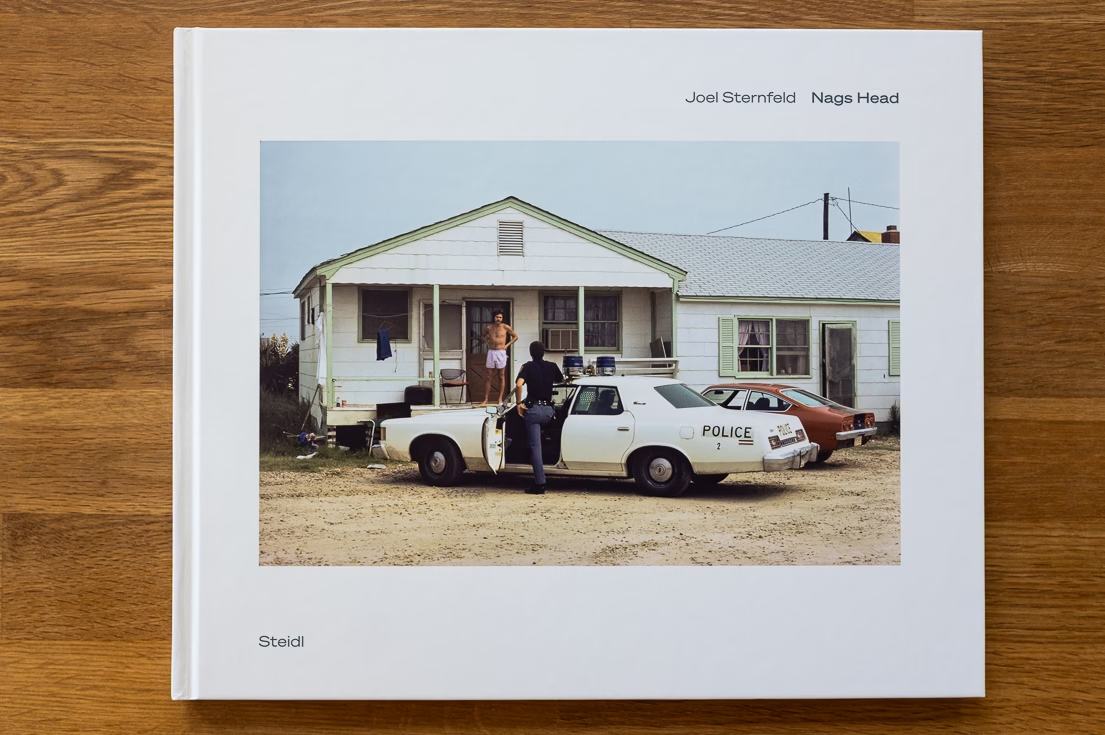
On my Bookshelf | Joel Sternfeld – Nags Head
On my Bookshelf
In this column, I occasionally present a photo book that is close to my heart. It is not – or not necessarily – a new publication. It is simply a book that somehow fell into my hands and that I would like to recommend to others. And yes – of course it’s on my bookshelf.
It’s a bit of a continuation of my “Photo book of the month” column – just not necessarily as regular as before. And I’ve generally made the column a bit shorter and tighter. I hope you’ll enjoy it!

Prologue
In my first “real” post since relaunching in the U.S., I’m taking it easy—at least a little—and I hope you’ll forgive me. I’m starting with a book review—a rather obvious one, at that—of an author I’ve already introduced elsewhere. I’m talking about Joel Sternfeld, whose famous work American Prospects I reviewed here some three years ago. To keep things simple—but at least a little personal—I’m featuring one of his books that I have a personal connection to: Nags Head. In this volume, Sternfeld portrays the quite famous vacation spot on the Outer Banks in North Carolina—a place synonymous with the idyllic American East Coast beach life (of days gone by?).
What’s my connection to it? At the end of October, we were in exactly this spot and spent a whole week’s holiday there.
About the Photographer | Joel Sternfeld
Joel Sternfeld was born in 1944 in New York/USA, where he still lives today. He is one of the most important pioneers of “New Colour Photography” and is often mentioned in the same breath as photographers such as Shore, Eggleston and Meyerowitz. His works have been and continue to be exhibited in well-known collections and museums, including the Museum of Modern Art (MoMa) in New York City.
Sternfeld deals with various themes of American reality in his works, which are usually very conceptual and organised as groups of works. He photographs the country and people of the USA meticulously, but also pointedly and in all their peculiarities and contradictions. Sternfeld’s American Prospects series in 1987 marked his highly acclaimed breakthrough as an important photographer.
Other important and highly acclaimed works include, for example, On This Side: Landscapes in Memoriam (1997), Stranger Passing (2001), and Walking the High Line (also 2001).
About the Photo Book | Nags Head
Nags Head is, in one sense, Joel Sternfeld’s latest book, published by Steidl in February 2024. In another sense, however, it is perhaps Sternfeld’s oldest book—because the photographs in the book were all taken in 1975, during a period before he began shooting primarily with an 8×10 large-format camera. To be perfectly precise, though, you can actually find at least some of these pictures in another book by Steidl, namely First Pictures from 2012. That book is out of print anyway.


Faced with the prospect of spinal surgery and the risk of almost complete physical paralysis, Sternfeld set out in the summer of 1975 in search of one last idyll – and found it in Nags Head on the Outer Banks of North Carolina. From June to August, he photographed this coastal town, which defies precise classification within any specific time period – perhaps even more so 50 years ago than it does today. In doing so, he captured a feeling that many of us may recognise from such places of longing. I shall return to this later, for it is undoubtedly the core of the work.


Sternfeld’s photographs show what makes Nags Head, and much of the Outer Banks, so distinctive: seemingly endless beaches and dunes, summer beachgoers of all ages, the typical Carolina beach houses on stilts, and the familiar trappings of a seaside town, from motels and beach bars to restaurants and parties. Above all, though, they convey a particular mood, and with it a feeling.


All of this was shot on 35mm, in colour, on Kodachrome. Colour was already the foundation of Sternfeld’s photographic language at the time, and it would become even more so later. In a short essay at the end of the book, illustrated with examples of his work, he explains his fascination with colour photography and his decision to commit to it, a decision that proved a milestone in his career.
As for the Outer Banks, I know from my own experience that black and white is hard to imagine there. Perhaps in winter, but then the pictures would say something else entirely.
The influence of this journey on Sternfeld’s subsequent work
That summer’s stay was cut short by tragedy: Sternfeld’s brother died. The photographer went back to New York and never returned to Nags Head. We will never know what else he might have photographed there, or whether Nags Head would have grown into a larger project spanning several years.
What we do know, because Sternfeld recounts it in the same essay, is that the stay and his brother’s death left a lasting mark on him. Trying to distract himself from grief through work, he was drawn to the beach again, this time not the Outer Banks but Rockaway Beach in New York City. There he took a photograph, and experienced a moment, that stayed with him for a long time and ‘opened his eyes’. Made in mourning and still shaped by what he had seen in Nags Head, that picture would lead, a few years later, to the now-famous colour compositions of American Prospects.


What I like about it
Let me come back to the feeling I mentioned earlier. On the East Coast you probably find it only in places like Cape Cod, Cape Ann or the Outer Banks. Sternfeld himself wrote of a “sense of temporal and spatial fluidity, a sense of oneirism”. Here you feel as though you are walking through Mom and Pop’s America, in a time that no longer exists, and perhaps never did, though that is another story. In Germany, where I come from, the equivalents might be Sylt, the East Frisian Islands, Rügen or, above all, Hiddensee. I suspect many of you know what I mean.
I love both: that particular world, and the slightly sentimental feeling of yesteryear that comes with it, even if here and there it can look a little dated and run-down.


You can, of course, read this book as a journey through time. But it is a very different journey from the one you take through pictures of New York or California in the ’50s, ’60s or ’70s. Here a piece of time has simply stood still or, as Sternfeld suggests, drifts through the years like a fluid. It still feels that way today: no longer 1975, but not quite 2026 either. Find the right spot, pay attention to the small details, and you are in neither year but somewhere in between.
That is what makes the book so compelling, especially if you know the Outer Banks yourself. If you don’t, it is harder to say. Purely as photography, Sternfeld’s later work is stronger – in a sense of more mature. But for anyone who knows the area, perhaps from childhood, the book is well worth a look, as it is for anyone interested in the New Color Photography of the last century.
I had meant to write more, but that would go beyond a short book review, so I will save it for a future post on the Outer Banks. For now, here are a few pictures as a preview.


No Comments